Cataract Surgery with Femtosecond Laser.
The most precise and modern version of cataract extraction available today. The laser performs critical steps with an accuracy impossible by hand, even for experienced surgeons.
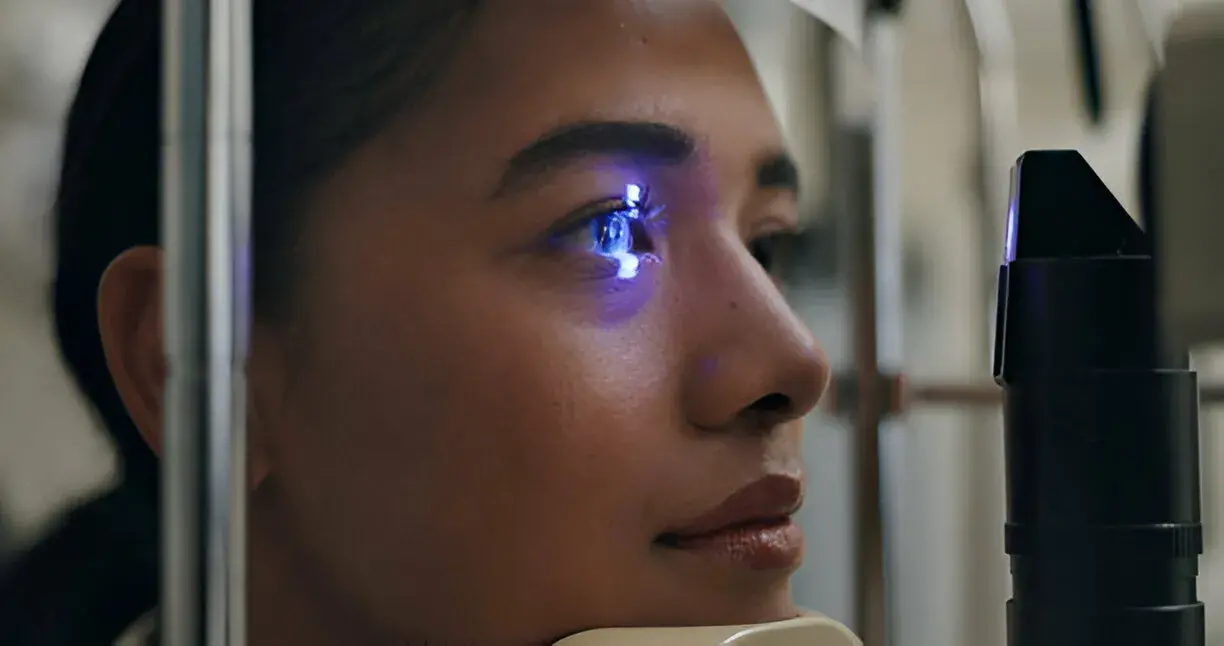
What makes the femtosecond laser different?
Unlike conventional surgery, which relies entirely on manual incisions, the laser performs several critical steps with an accuracy that is impossible to achieve by hand.
At VISTAR we use state-of-the-art technology, chosen because it improves the results and safety of the procedure — not because it is trendy.
Real, measurable advantages.
Here are the concrete patient benefits that femtosecond technology delivers.
More precise incision edges
The laser creates incisions with exact geometry, which improves wound stability and reduces surgical variability. It does not depend on a manual pulse; it follows a pattern reproducible to the micrometer.
Perfectly centered capsular opening
The capsulorhexis — the "window" opened to remove the cataract — is one of the most critical parts of the surgery. The laser makes it round, symmetric and centered, improving the final position of the intraocular lens and the predictability of the visual outcome.
Gentler cataract fragmentation
The laser splits the lens before aspirating it, allowing less ultrasonic energy to be used during surgery. Less trauma to internal tissues, potentially faster recovery and less postoperative inflammation.
Real personalization of the procedure
The laser is programmed for each eye based on the patient's anatomical dimensions and characteristics. It is not a "standard" procedure — it is surgically personalized.
Greater safety in critical steps
The laser's precision reduces risks in challenging situations: mature or very dense cataracts, zonular weakness, eyes smaller or larger than usual, small pupils. The technology helps the surgeon maintain absolute control over every key stage.
Why we use this technology.
At VISTAR we don't use lasers for fashion or marketing. We adopt them because they represent:
- More surgical precision
- More safety in critical steps
- Less variability between procedures
- Better intraocular lens positioning
- More stable results and greater control
The laser does not replace the surgeon — it enhances their ability to achieve more consistent results.
Related articles
More reading on this procedure from our ophthalmology specialists.
-
 Prevention
Why You Should Get Your Eyes Checked Yearly, Even If You See Fine
Many eye diseases cause no symptoms until it is too late. An annual exam is the best investment.
-
 Retina
Age-related Macular Degeneration (AMD): What You Should Know
Straight lines that appear wavy or a central spot: may be AMD symptoms. Early detection is key.
-
 Eye Urgencies
Conjunctivitis: Types and When to See an Ophthalmologist
Viral, bacterial or allergic: each conjunctivitis has a different treatment. Not every eye drop works.
Leave us your details and we will contact you within 24 business hours.
What our patients ask.
Direct answers about procedures, recovery times, candidacy and cost. If you don't find what you're looking for, contact us and a specialist will reply personally.
Candidacy is determined in a pre-assessment including corneal topography, pachymetry, refraction and fundus exam. At ViSTAR we only operate when it truly makes sense.
No. We use topical anesthetic drops that completely eliminate pain. The procedure lasts about 10 minutes per eye.
For FemtoLASIK: functional vision in 24 hours. For PRK: 5 to 10 days. For cataract with Premium IOL: clear vision in 24–48 hours.
Refractive surgery ranges from $25,000 to $45,000 MXN per eye. We offer interest-free payment plans.
A Premium Intraocular Lens replaces the crystalline lens and lets you see far, intermediate and near without glasses.
Yes. We offer corneal cross-linking, intrastromal rings and scleral lenses. Early topography-based diagnosis is key.
The corneal change is usually stable, though vision may shift over time due to age, presbyopia or other eye conditions — natural processes independent of the surgery.
Come accompanied, with no makeup or perfume. The full visit takes between 60 and 90 minutes including prep and immediate post-op.
Yes. We receive patients from Chihuahua, New Mexico, Texas and Arizona. We coordinate prior virtual consultation and surgery in the same trip when possible.
We use femtosecond laser, excimer laser with active eye tracking, and Scheimpflug systems for 3D corneal topography. Alcon, Johnson & Johnson and Zeiss platforms.