Presbyopia Surgery and Premium Intraocular Lenses.
Presbyopia is why reading, looking at your phone or focusing up close starts to get harder, even if you see well at a distance. Premium lenses are state-of-the-art optical designs that widen your range of vision and reduce dependence on glasses.
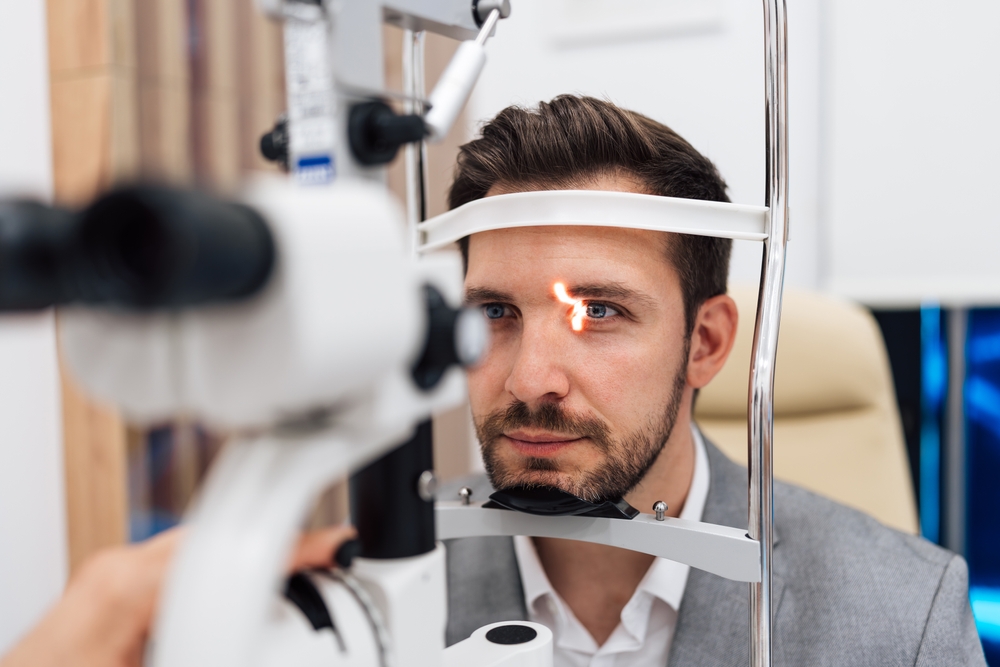
What makes this surgery different?
The natural lens loses flexibility with age. Premium lenses replace that function with designs that allow vision at different distances depending on the model chosen.
It is not magic: it is advanced optics. The lens choice is not standard — it is based on the patient's real activities and visual expectations.
Types of premium lenses we use.
No commercial promises — only real advantages backed by evidence.
Multifocal / Trifocal
They offer several focal points. They can reduce the use of reading glasses and improve intermediate vision. Ideal for patients seeking full independence from glasses.
EDOF (Extended Depth of Focus)
They extend the range of vision without splitting light into multiple zones. They tend to offer good intermediate and distance vision with fewer halos at night — ideal for night driving.
Toric
They correct astigmatism and improve sharpness without the need for additional surgery. They can be combined with trifocal or EDOF designs in the same lens.
Lens replacement
We replace the natural lens that has lost flexibility with an advanced optical design. The procedure is the same as cataract surgery, but performed before opacity develops.
Precision in lens positioning
A premium lens works best when perfectly aligned. We use technology that helps center it exactly, maximizing final visual quality.
Personalized vision ranges
Depending on the lens type, distance, intermediate (computer, car dashboard) or near (reading) vision can be improved. Each case is tailored to real visual needs.
Our selection criteria.
We choose the right lens by evaluating:
- The patient's daily activities
- Realistic visual expectations
- Ocular anatomy (cornea, pupil, axial length)
- Presence of astigmatism
- Tolerance to nighttime halos
- Preference between reading and intermediate vision
Premium lenses do not guarantee "perfect vision without glasses," but they can significantly reduce the use of glasses in everyday activities. The benefit depends on the lens type and the eye's anatomy.
Related articles
More reading on this procedure from our ophthalmology specialists.
-
 Presbyopia
Presbyopia: Why It Shows Up at 40 and What to Do
Reading messages with your phone at arm’s length is the first sign. Presbyopia is natural and has several modern solutions.
-
Cataract
Cataract Surgery with Premium IOL: Which Lens to Choose
Monofocal, EDOF or trifocal: learn the differences between premium intraocular lenses and which suits you.
-
 Prevention
Why You Should Get Your Eyes Checked Yearly, Even If You See Fine
Many eye diseases cause no symptoms until it is too late. An annual exam is the best investment.
What our patients ask.
Direct answers about procedures, recovery times, candidacy and cost. If you don't find what you're looking for, contact us and a specialist will reply personally.
Candidacy is determined in a pre-assessment including corneal topography, pachymetry, refraction and fundus exam. At ViSTAR we only operate when it truly makes sense.
No. We use topical anesthetic drops that completely eliminate pain. The procedure lasts about 10 minutes per eye.
For FemtoLASIK: functional vision in 24 hours. For PRK: 5 to 10 days. For cataract with Premium IOL: clear vision in 24–48 hours.
Refractive surgery ranges from $25,000 to $45,000 MXN per eye. We offer interest-free payment plans.
A Premium Intraocular Lens replaces the crystalline lens and lets you see far, intermediate and near without glasses.
Yes. We offer corneal cross-linking, intrastromal rings and scleral lenses. Early topography-based diagnosis is key.
The corneal change is usually stable, though vision may shift over time due to age, presbyopia or other eye conditions — natural processes independent of the surgery.
Come accompanied, with no makeup or perfume. The full visit takes between 60 and 90 minutes including prep and immediate post-op.
Yes. We receive patients from Chihuahua, New Mexico, Texas and Arizona. We coordinate prior virtual consultation and surgery in the same trip when possible.
We use femtosecond laser, excimer laser with active eye tracking, and Scheimpflug systems for 3D corneal topography. Alcon, Johnson & Johnson and Zeiss platforms.