Refractive Surgery at VISTAR.
We correct myopia, astigmatism and hyperopia so the eye focuses better. We offer the full spectrum of techniques — FemtoLASIK, PRK, TransPRK, ICL, toric ICL, refractive lens exchange, bioptics — and we choose the one that truly fits each case.
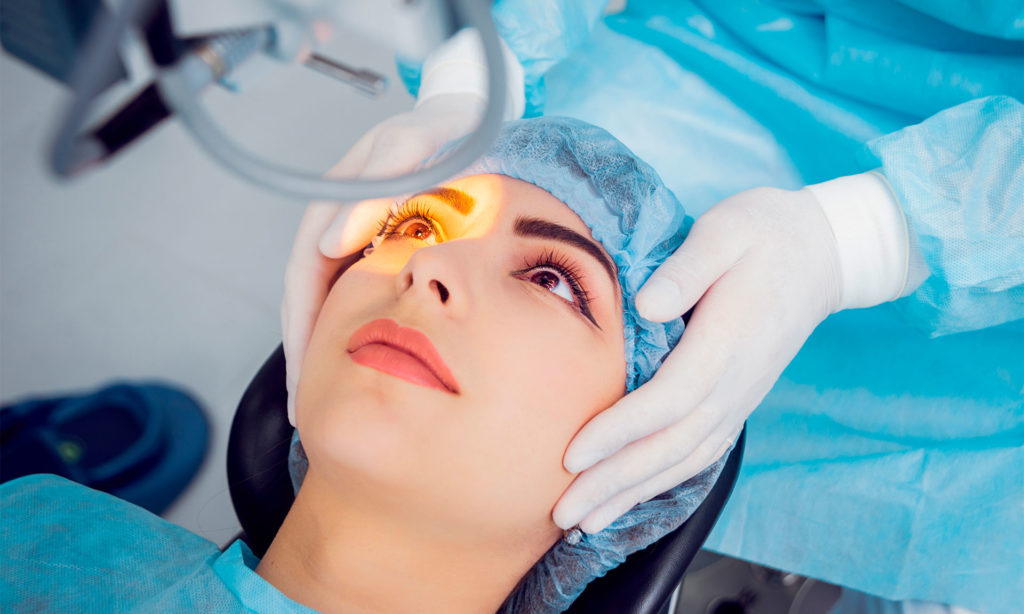
Not every eye needs the same solution.
That is why we work with every refractive technique and choose the one that truly fits each case, always prioritizing safety, precision and visual quality.
The decision is based on detailed diagnostic studies — topography, pachymetry, fundus analysis — not on trends or on the most commonly used technique.
Techniques we use.
Each technique has specific indications. We select the best option based on your anatomy, prescription and visual goals.
FemtoLASIK
When the anatomy allows it, it offers fast recovery and highly predictable results thanks to the flap created with a femtosecond laser. The most popular technique for good reasons.
PRK
Indicated for thin corneas, previous surgeries or irregular surfaces. It eliminates the need for a flap and offers long-term stability. Slower recovery, but equally precise results.
TransPRK
A fully laser-guided variant of PRK. Useful for patients who are not flap candidates and want a more uniform surface procedure, with no mechanical contact with the cornea.
Phakic ICL lenses
Indicated for high prescriptions or corneas not suitable for laser. They provide excellent visual quality without altering the corneal structure — reversible if necessary.
Toric ICL
For patients with significant astigmatism who need precise correction without reshaping the cornea. It combines the advantages of the ICL with astigmatism correction.
Bioptics
A combination of a phakic lens and laser surgery in the same eye to fine-tune residual prescription. Used when a single technique does not deliver the optimal result.
Refractive lens exchange
Indicated for older patients or those with signs of presbyopia or early cataract. It offers stable refractive correction and eliminates the future need for cataract surgery.
Enhancements of previous surgeries
To optimize results in patients operated years ago or with natural changes in their prescription. The decision is made after evaluating stability and residual corneal thickness.
Our approach.
We don't operate with a fixed preference. The technique is chosen for the option that offers:
- Better long-term stability
- Greater preservation of corneal thickness
- Less impact on the ocular surface
- Better visual quality for that patient
- Solid clinical evidence, not trends
A refractive plan designed for your eyes — not a one-size-fits-all solution.
Related articles
More reading on this procedure from our ophthalmology specialists.
-
 Refractive Surgery
FemtoLASIK Surgery: What to Expect Before, During and After
Everything you need to know about FemtoLASIK surgery: candidacy, procedure and recovery in Ciudad Juárez.
-
Prevention
Why You Should Get Your Eyes Checked Yearly, Even If You See Fine
Many eye diseases cause no symptoms until it is too late. An annual exam is the best investment.
-
 Retina
Age-related Macular Degeneration (AMD): What You Should Know
Straight lines that appear wavy or a central spot: may be AMD symptoms. Early detection is key.
Leave us your details and we will contact you within 24 business hours.
What our patients ask.
Direct answers about procedures, recovery times, candidacy and cost. If you don't find what you're looking for, contact us and a specialist will reply personally.
Candidacy is determined in a pre-assessment including corneal topography, pachymetry, refraction and fundus exam. At ViSTAR we only operate when it truly makes sense.
No. We use topical anesthetic drops that completely eliminate pain. The procedure lasts about 10 minutes per eye.
For FemtoLASIK: functional vision in 24 hours. For PRK: 5 to 10 days. For cataract with Premium IOL: clear vision in 24–48 hours.
Refractive surgery ranges from $25,000 to $45,000 MXN per eye. We offer interest-free payment plans.
A Premium Intraocular Lens replaces the crystalline lens and lets you see far, intermediate and near without glasses.
Yes. We offer corneal cross-linking, intrastromal rings and scleral lenses. Early topography-based diagnosis is key.
The corneal change is usually stable, though vision may shift over time due to age, presbyopia or other eye conditions — natural processes independent of the surgery.
Come accompanied, with no makeup or perfume. The full visit takes between 60 and 90 minutes including prep and immediate post-op.
Yes. We receive patients from Chihuahua, New Mexico, Texas and Arizona. We coordinate prior virtual consultation and surgery in the same trip when possible.
We use femtosecond laser, excimer laser with active eye tracking, and Scheimpflug systems for 3D corneal topography. Alcon, Johnson & Johnson and Zeiss platforms.